
Escape Room Website Design History
From basic HTML pages to immersive digital experiences — how escape room websites have evolved alongside the industry itself.
The Evolution of Escape Room Website Design
The escape room industry has undergone a remarkable transformation since its inception in the early 2010s. As the physical experiences evolved from simple lock-and-key puzzles to theatrical, technology-driven adventures, so too did the websites that marketed them.
Understanding this evolution isn't just a history lesson — it provides crucial context for why certain design patterns work today and helps us anticipate where the industry is heading next.
The Pioneer Era (2010–2014)
The first escape rooms emerged from Japan and Hungary in the late 2000s, quickly spreading to the US, UK, and beyond. In these early days, most escape room websites were little more than digital business cards — basic HTML pages with a phone number, address, and perhaps a grainy photo or two.
Online booking was largely handled by generic appointment tools like Bookeo, and many bookings still came in by phone or email. The websites reflected the nascent state of the industry: functional, but with little attention to branding or user experience. Many operators were puzzle enthusiasts first and business owners second, and their websites showed it.
We started our first venue, Escape Hour in Edinburgh, in late 2014. At that point there were fewer than 20 escape room venues in the entire United Kingdom. That context explains why web design was so rudimentary: there simply weren't many polished examples to learn from, and with most venues operating on tight budgets, few invested in professional web work.
The image opposite is a screenshot from Trap Escape Rooms in Budapest, circa April 2014. TripAdvisor logos and reviews were heavily used on the homepage. Images would have been slow and clunky by today's standards. You would always have to fill in a captcha to send a message on a contact form. For the record, the two games that just about every escape room owner in Europe went over to play were called "Egyptian" and "Medieval". Everyone went to play them to see the first electronics that were being used in escape rooms.
Escape room owners were generally "jack of all trades" types who built their sites with WordPress builders like WPBakery. Elementor — now one of the most widely used page builders — wasn't even launched until 2016, which tells you how primitive the tooling was. The aesthetic of the era leaned heavily on dark backgrounds and neon text in an attempt to evoke mystery, though the result was often illegible. Navigation was an afterthought, and mobile optimisation was virtually nonexistent.
As larger multi-venue operators began to emerge, they had the budget to hire proper web designers, and WordPress templates aimed specifically at escape rooms became more widely available. The designs were generic, but they did the job — the average customer at the time was a first-timer who simply didn't know what a great booking experience could look like.
A Different Era
In 2014, there were fewer than 100 escape rooms in the entire world. By 2019, that number had exploded to over 14,000. This massive growth forced rapid professionalisation across all aspects of the business, including web presence.
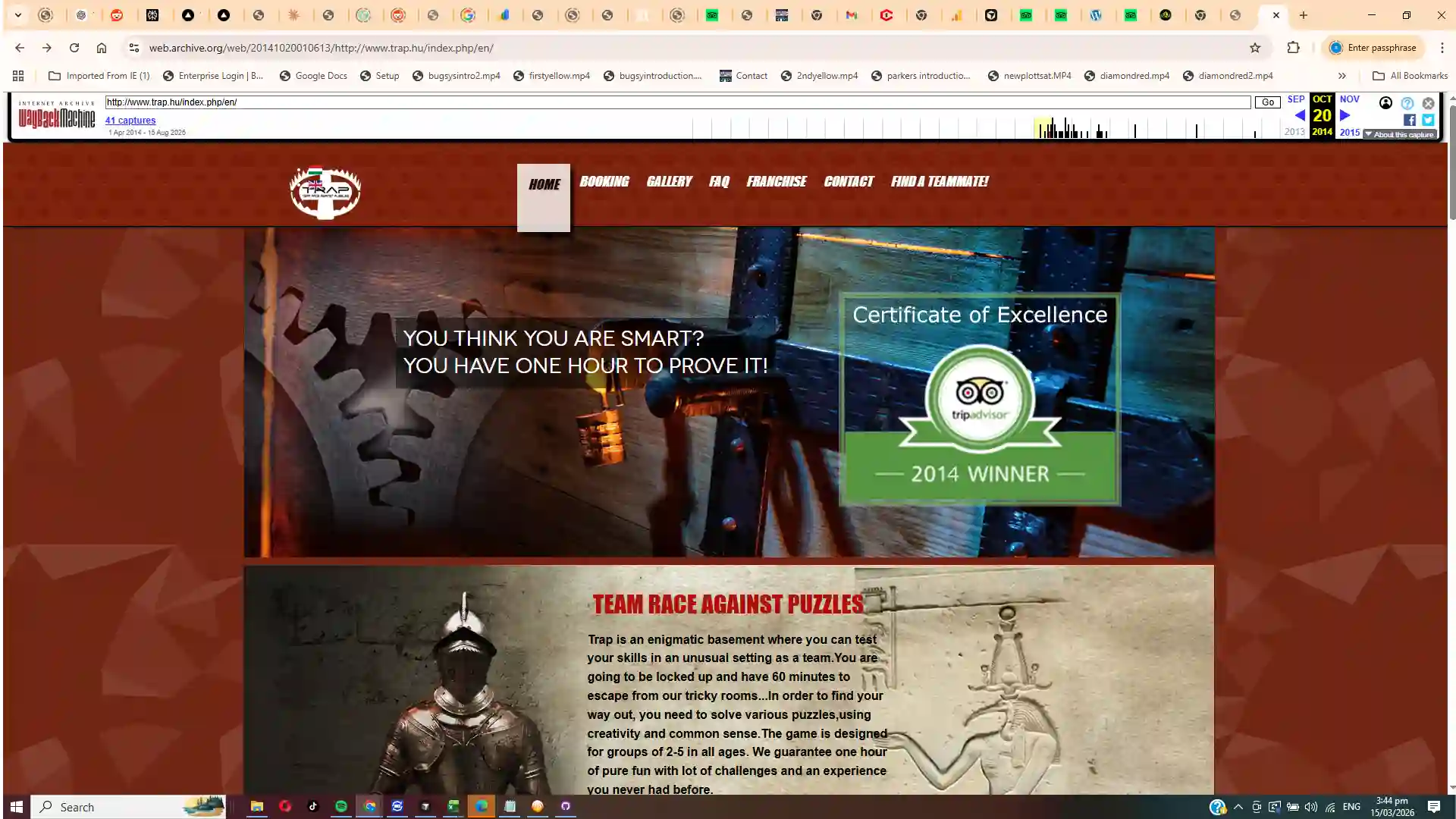
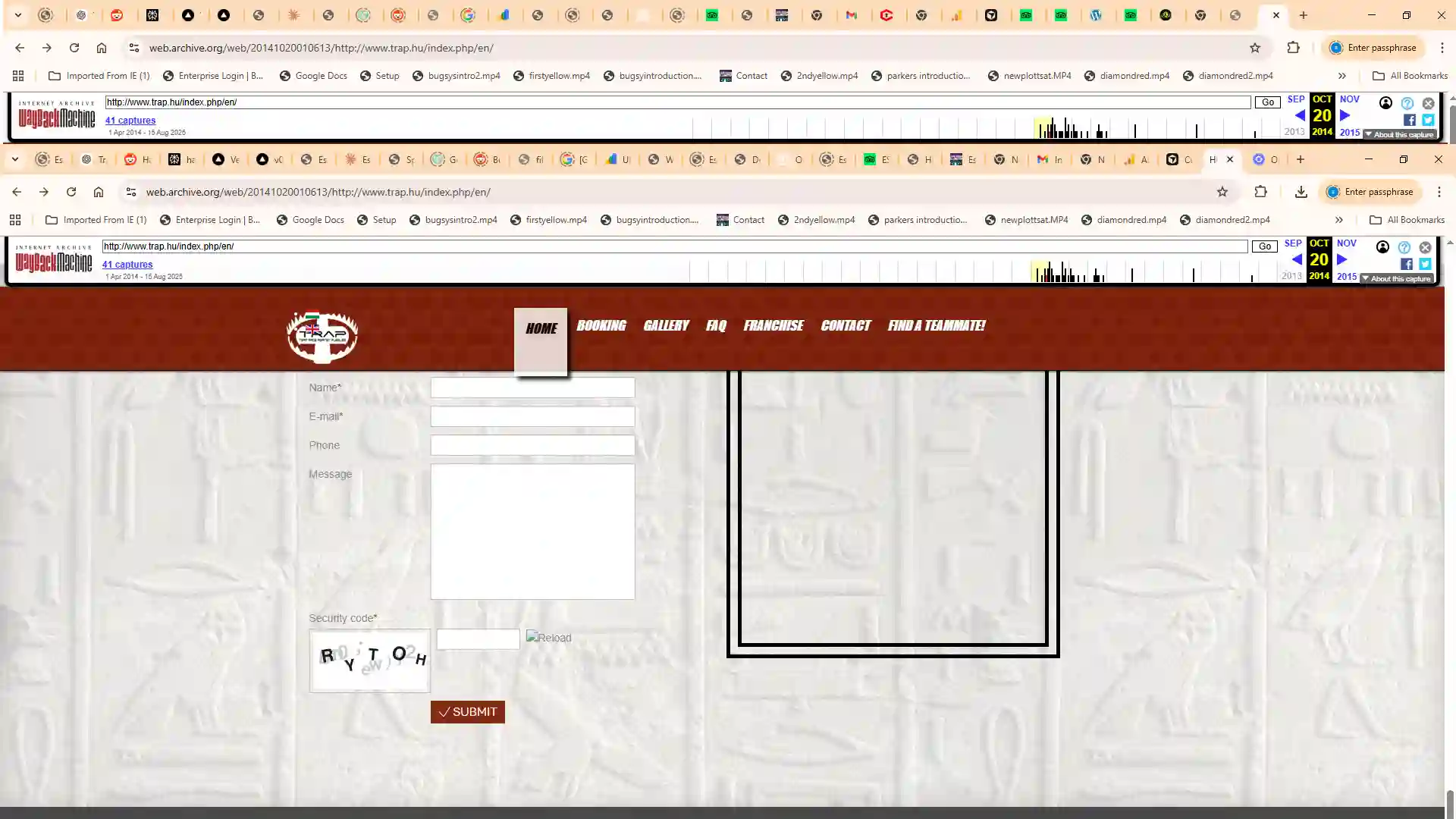
Screenshots from Trap Escape Rooms in Budapest.
The Growth Phase (2015–2017)
As the industry grew, so did competition. Operators began to realize that their website was often the first point of contact with potential customers — and that a poor web experience could cost them bookings.
This era saw the rise of escape room-specific booking platforms like Bookify, which later became Resova. Bookeo improved their offering and designed integrations specifically for escape rooms. For the first time, operators could offer real-time online booking without building custom systems. However, integration was often clunky, with jarring redirects to external booking pages that looked nothing like the main site.
WordPress became the platform of choice, offering better design options as pre-made templates became more widely available. Theme-based websites proliferated, leading to a certain homogeneity — many escape room sites looked remarkably similar, distinguished only by their logos and room photos.
Social proof began to emerge as a key differentiator. TripAdvisor rankings became badges of honour, prominently displayed on homepages. Customer review widgets appeared, though often poorly integrated with site design.
The Maturation Period (2018–2020)
By 2018, the escape room market was maturing. Customers had more options than ever, and operators needed to stand out. This drove a significant uplift in website quality across the industry.
Video trailers became standard for premium rooms. High-quality photography replaced stock images. Responsive design became mandatory as mobile traffic surpassed desktop. Operators invested in professional branding, and websites began to reflect genuine brand identities rather than generic templates.
The booking experience improved dramatically. Embedded booking widgets became smoother, and some operators built fully custom booking systems. Calendar views, dynamic pricing, and instant confirmation became table stakes.
This era also saw increased attention to page speed and SEO. Operators realised that ranking on Google for "escape room [city name]" could make or break a business. Technical optimisation became part of the conversation alongside visual design.
The COVID Pivot
The pandemic of 2020 forced many escape rooms to pivot to virtual experiences. Websites suddenly needed to explain and sell an entirely new product category, leading to rapid iteration in how online escape games were presented and marketed.
The Modern Era (2021–Present)
Today's best escape room websites are sophisticated marketing machines. They combine atmospheric design with conversion optimisation, balancing brand storytelling with clear calls to action.
Key characteristics of modern escape room web design include:
- Immersive hero sections — Full-screen video backgrounds, parallax effects, and cinematic imagery that immediately establishes atmosphere (see our design guide)
- Strategic social proof — Reviews, ratings, and player counts woven throughout the site (explore conversion best practices)
- Frictionless booking — Embedded, branded booking experiences that feel native to the site
- Mobile-first design — With over 60% of bookings now happening on mobile devices, responsive design is essential
- Performance optimisation — Fast-loading pages that don't sacrifice visual impact (speed matters)
- Accessibility considerations — Ensuring all potential customers can navigate and book regardless of ability
The gap between professional and amateur escape room websites has never been wider. Top operators invest significantly in their digital presence, understanding that a great website is as important as great room design.
The Future of Escape Room Web Design
Where is escape room web design heading? Several trends are emerging:
- Virtual and augmented reality previews — 360-degree room tours and AR experiences that let customers "peek inside" before booking
- AI-powered personalisation — Dynamic content that adapts based on visitor behaviour, showing relevant rooms and offers (see website tools for modern builders)
- Enhanced social integration — Deeper connections with social platforms for sharing, reviews, and community building
- Gamified websites — Interactive elements that give visitors a taste of the puzzle-solving experience before they arrive
- Sustainability messaging — As consumers become more environmentally conscious, expect to see more eco-friendly messaging integrated into escape room brands
The operators who stay ahead of these trends will have a significant competitive advantage. The websites of 2030 will look very different from those of today — just as today's sites are unrecognisable compared to the basic pages of 2012.
Stay Curious
The best escape room operators are constantly learning from other industries. Look at how hospitality, entertainment, and e-commerce sites evolve — many of their innovations can be adapted for escape room marketing.